Henry Scott Tuke 1858-1929
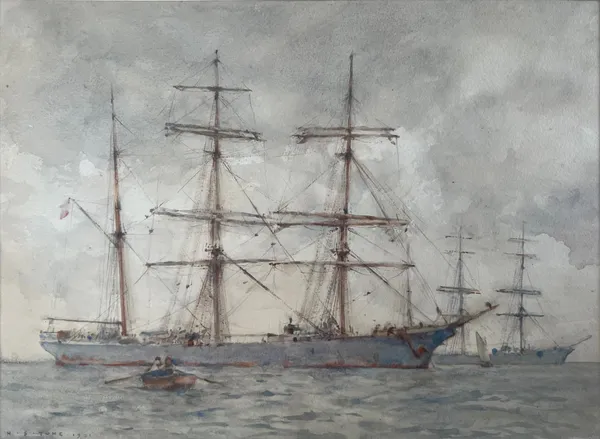
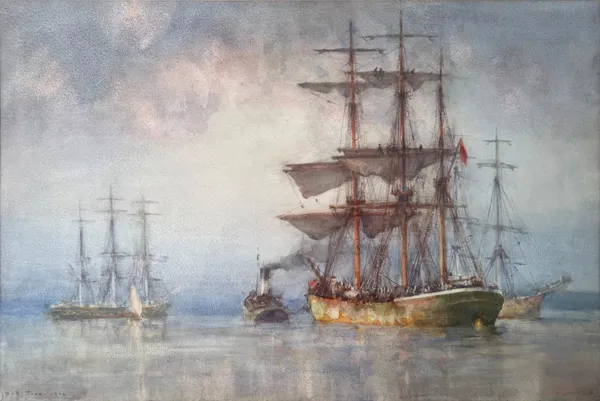
French Barque, 1914
Watercolour on paper
45.7 x 30.5 cm (18 x 12 ins.)
Framed: 64 x 48.9 cm (25 3/16 x 19 1/4 x ins.)
Framed: 64 x 48.9 cm (25 3/16 x 19 1/4 x ins.)
Available to buy
Provenance
With the Fine Arts Society, London, 1960.
Exhibitions
Fine Arts Society, London, 1960.
Henry Scott Tuke’s depictions of ships in Falmouth Harbour exemplify his technical mastery in watercolour and his deep engagement with maritime life. Although perhaps better known for his figurative oils, Tuke’s maritime watercolours reveal a nuanced understanding of light, atmosphere, and the daily rhythms of a working harbour. His watercolour technique is both fluid and precise, capturing the ephemeral qualities of water and sky while maintaining structural accuracy and clarity in the depiction of ships and rigging. This duality reflects his training at the Slade and the influence of French impressionism, particularly in his emphasis on natural light and the immediacy of his brushwork.
Tuke delighted in the detail of a fully rigged barque and since childhood could draw such from memory. His compositions often site vessels at rest in Falmouth harbour (famously the third deepest natural harbour on earth). These works also engage with broader themes of British maritime identity during a period of imperial and industrial transition. Steam-electric turbines became prevalent in ships from the early 1900s so these are the last days of commercially viable sailing ships and in one respect Tuke’s beautiful paintings of this era lament that demise, and recall a more elegant age of sail. The steam tug pushing the bow of the barque in the present work is a poignant reminder of this maritime shift.
1
of
10
Related artworks
-
 Henry Scott TukeBarques at Anchor in Falmouth, 1921Watercolour on paper25.3 x 35.4cm (10 x 14 ins.)
Framed: 47.7 x 51.7cm (18 3/4 x 22 5/16 ins.) -
Henry Scott TukeFrench Barque, 1914Watercolour on paper45.7 x 30.5 cm (18 x 12 ins.)
Framed: 64 x 48.9 cm (25 3/16 x 19 1/4 x ins.) -
Henry Scott TukeGroup of French Ships and Barque, 1914Watercolour on paper34 x 49cm (13 1/2 x 19 1/4 ins.)Sold
Framed: 53 x 67.7cm (20 7/8 x 26 3/4 ins.) -
Henry Scott TukeTowing into Falmouth, 1912Watercolour on paper30.5 x 45.7 cm (12 x 18 ins)Sold
Framed: 51.4 x 65.1 cm (20 1/4 x 25 5/8 ins)